Best Fish Oil for Dogs: Dosage, Brands & Prices Compared
Fish oil for dogs compared: EPA/DHA per serving, price per dose and vet-based dosing estimates, so you can pick the right supplement for your dog's size.
If you searched for fish oil for dogs, you are probably standing in front of a shelf (or a browser tab) full of bottles that all promise shinier coats and healthier joints, with no easy way to tell which one is worth the money. Most articles on this topic explain what omega-3s do in general terms but stop short of telling you how much to give a dog of your size or which product is actually the best value per ounce.
This guide answers both questions. It compares five real fish oil products for dogs by price, size, and cost per ounce, and it lays out a weight-based dosing range built from published veterinary sources - not a marketing claim on a bottle label.
Quick answer:
Budget pick: Salmon Oil for Dogs, 8 oz ($9.98, about $1.25/oz) - the cheapest way to try liquid fish oil before committing to a bigger bottle.
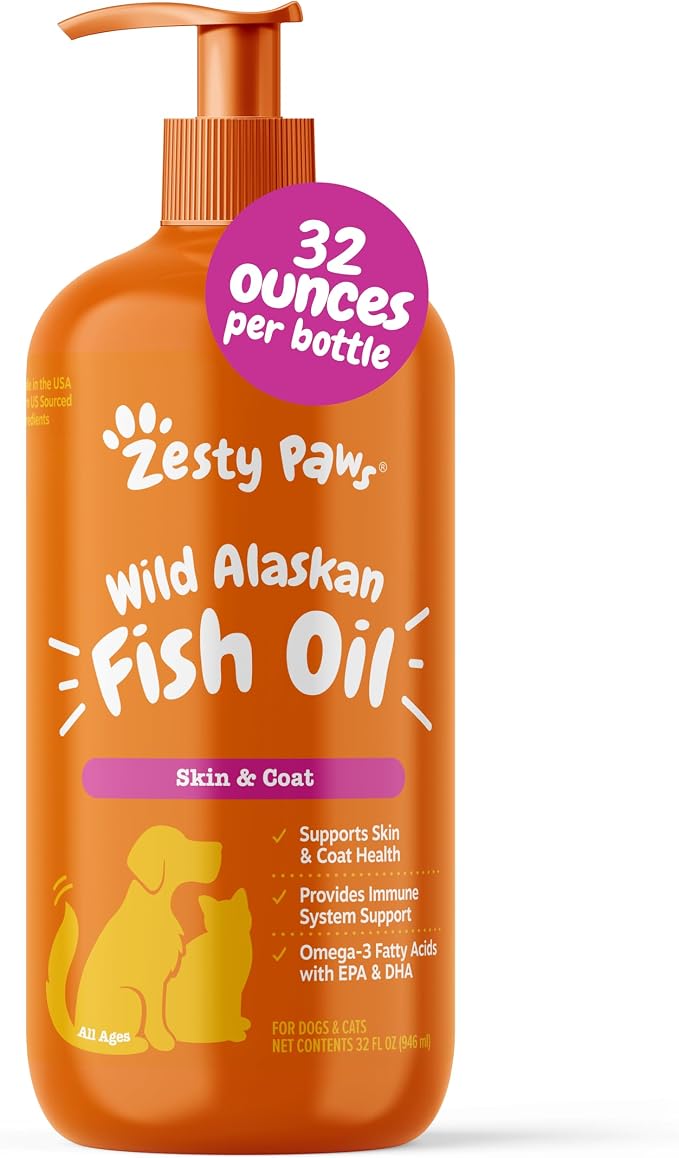
Best overall: Zesty Paws Fish Oil for Dogs & Cats, 32 oz ($34.97, about $1.09/oz) - a widely stocked brand in a mid-size bottle that most households finish before it expires.
Best for large or multiple dogs: Fish Oil for Dogs, Salmon Pollock Liquid Omega-3, 64 oz ($49.95, about $0.78/oz) - the lowest cost per ounce of the five, which matters once a 70-plus pound dog is going through a bottle every few weeks.
Fish oil for dogs: price and size comparison
All five products below are liquid fish oil supplements sold on Amazon. Prices and sizes are current as of the check date at the bottom of this article and can change.
Product
Size
Price
Price per oz
Pick this if...
Fish Oil for Dogs, Salmon Pollock Liquid Omega-3
64 oz
$49.95
$0.78
You have a large dog or more than one dog and want the lowest cost per ounce
Zesty Paws Fish Oil for Dogs & Cats
32 oz
$34.97
$1.09
You want a well-known brand in a bottle sized for one medium dog
Amazon Basics Wild Alaskan Salmon Oil
8 fl oz
$13.59
$1.70
You want a small trial size from a retailer you already order from
Fera Pets Liquid Fish Oil (Non-GMO, with Vitamin E)
16 oz
$39.95
$2.50
You prioritize a non-GMO label and added vitamin E over price per ounce
Salmon Oil for Dogs (Premium, for Itchy Skin)
8 oz
$9.98
$1.25
You want the lowest total price to test fish oil for the first time
How much fish oil should I give my dog?
Fish oil dosing for dogs is measured in milligrams of combined EPA and DHA (the two active omega-3 fatty acids), not milliliters of oil, because different products pack different amounts of EPA/DHA into the same size dose. Published veterinary sources give a therapeutic range rather than one fixed number:
Today's Veterinary Practice reports that "recommended doses of EPA and DHA supplements for therapeutic purposes range from 50 to 220 mg/kg body weight," with 220 mg/kg cited for osteoarthritis management.
Colorado State University's Veterinary Health System dosing chart sets a maximum of 310 mg/kg0.75 (metabolic body weight) of combined EPA/DHA per day for dogs with osteoarthritis, and advises starting at roughly a quarter of that maximum and increasing slowly while watching for loose stools or vomiting.
The National Research Council's safe upper limit for total EPA and DHA in dogs is 280 mg per 100 kcal of diet, a separate ceiling based on total calorie intake.
The table below is not an official dosing chart from any single source. It is this guide's own arithmetic, derived by applying the published range above to common dog weights: the lower end (about 50 mg/kg/day) as a general wellness starting point, and the higher end (220 mg/kg/day) as the vet-supervised therapeutic ceiling. The daily combined EPA/DHA amount works out to approximately:
Dog's weight
Weight in kg
General wellness dose (~50 mg/kg)
Therapeutic ceiling (~220 mg/kg, vet-supervised)
10 lb
4.5 kg
~225 mg/day
~1,000 mg/day
20 lb
9.1 kg
~455 mg/day
~2,000 mg/day
30 lb
13.6 kg
~680 mg/day
~3,000 mg/day
50 lb
22.7 kg
~1,135 mg/day
~5,000 mg/day
70 lb
31.8 kg
~1,590 mg/day
~7,000 mg/day
100 lb
45.4 kg
~2,270 mg/day
~10,000 mg/day
Figures above are calculated, not quoted from a single published chart - see the three sources cited above for the underlying ranges.
These are combined EPA+DHA milligrams per day, not milliliters of fish oil. Check the supplement facts panel on the specific bottle you buy for its actual EPA+DHA content per pump or per capsule, then do the math for your dog's weight - do not assume one "scoop" or "pump" is the same dose across brands.
Check with your vet before starting fish oil, especially before dosing anywhere near the therapeutic ceiling. AKC's veterinary guidance states plainly that "fish oil dosage depends on factors such as your dog's weight, age, health status, and diet" and advises talking to your vet rather than relying only on package directions. This matters more, not less, for dogs with existing health conditions or dogs on other medications.
What EPA and DHA actually do for a dog
EPA and DHA are the two long-chain omega-3 fatty acids found in fish oil. According to AKC's veterinary-reviewed overview, they support skin, coat, joint, heart, brain, and immune health, and help support a normal inflammatory response. VCA Hospitals' client information sheet lists fish oil among supplements used for inflammatory diseases including arthritis and kidney disease, among others such as heart disease, inflammatory bowel disease, and diabetes.
Fish oil is a supplement, not a medication, and it will not replace a veterinary treatment plan for a diagnosed condition. Its role is supportive.
Liquid, capsules, or chews - which form fits your dog
All five products compared above are liquid fish oil, which is the most common form for dogs because it is easy to dose by weight (pump directly onto food) and easy to scale up as a puppy grows or a dog gains or loses weight. The tradeoffs to know before choosing a form:
Liquid: Cheapest per ounce, easiest to dose precisely, but needs refrigeration after opening and has a shorter shelf life once opened.
Capsules: No refrigeration needed and no fishy mess on your hands, but harder to dose precisely for very small or very large dogs without cutting or combining capsules.
Soft chews: Easiest to give a food-motivated dog, but usually the most expensive per mg of EPA/DHA and often contain added flavoring or fillers.
If cost per ounce and dosing accuracy matter most to you, liquid is the practical default, which is also why it dominates this comparison.
Safety: side effects and when to avoid fish oil
Fish oil is generally considered safe for dogs at appropriate doses, but it is not risk-free. VCA Hospitals lists mild gastrointestinal upset, fishy odor, delayed wound healing, oily coat, and itchiness or skin flaking as common side effects. AKC's guidance adds diarrhea, vomiting, excessive gas, and fishy-smelling breath or skin as common reactions, with weight gain, pancreatitis, delayed wound healing, allergic reactions, and potential vitamin toxicity listed as less common but more serious effects.
VCA Hospitals specifically advises against fish oil for dogs with known allergies to fish oil components, or when a reputable, tested source of fish oil cannot be confirmed (due to heavy metal contamination risk). The same source says to use fish oil with caution in dogs taking anticoagulant medication, dogs with blood clotting disorders, diabetic dogs, dogs with a history of pancreatitis, dogs with diarrhea, and pregnant or nursing dogs. Serious reactions requiring immediate veterinary attention include allergic reactions, abnormal bruising or bleeding, pancreatitis symptoms, appetite loss, and incoordination or seizures.
Because dosing errors and drug interactions are the main real risks with fish oil, always check with your vet before starting a new supplement or increasing a dose, particularly if your dog is on any other medication, has a bleeding or clotting condition, or has a history of pancreatitis.
Common mistakes when giving fish oil to dogs
Dosing by "pumps" instead of milligrams. Bottles vary in EPA/DHA concentration - always check the supplement facts panel, not just the serving suggestion.
Jumping straight to the therapeutic dose. CSU's dosing chart recommends starting around a quarter of the maximum dose and increasing gradually to watch for loose stools or vomiting.
Using human fish oil capsules without checking the formula. AKC's guidance warns that human fish oil products can contain ingredients that are unsafe for pets, so a dog-specific product is the safer default.
Storing liquid fish oil at room temperature after opening. This speeds up rancidity, which can upset a dog's stomach and reduce the product's effectiveness.
Ignoring existing medication. Fish oil can raise bleeding risk in dogs already on anticoagulants, which is a conversation for your vet, not a guess.
Where to buy fish oil for dogs cheaper
Based on the price-per-ounce numbers above, the 64 oz bottle is the clear value option for large dogs or multi-dog households at $0.78/oz, versus $1.25 to $2.50/oz for the smaller bottles. If you only need to confirm your dog tolerates fish oil before committing to a large bottle, the 8 oz options let you test it for under $15 total. Prices on any of these listings can shift, so compare the current price per ounce rather than the sticker price alone before buying.
Frequently asked questions
Is fish oil a good dietary supplement for every dog?
For most healthy adult dogs, fish oil is a reasonable dietary supplement for skin, coat, and joint support. It is not automatically appropriate for dogs with bleeding disorders, pancreatitis history, or dogs on certain medications, which is why VCA Hospitals lists those as caution or avoid categories. Check with your vet first if your dog fits any of those categories.
Can I give my dog human fish oil supplements?
You can in some cases, but AKC's guidance specifically warns that human fish oil products "may contain ingredients that are unsafe for pets," such as added flavorings or other supplements dosed for human body weight. A dog-formulated product removes that guesswork.
What is the right fish oil dosage for a 50-pound dog?
Using the published 50 to 220 mg/kg combined EPA/DHA range, a 50 lb dog (about 22.7 kg) falls between roughly 1,135 mg/day at the general wellness end and up to about 5,000 mg/day at the vet-supervised therapeutic ceiling for conditions like osteoarthritis. Confirm the exact number with your vet before dosing at the higher end.
How long does it take for fish oil to improve a dog's skin and coat?
None of the veterinary sources cited in this guide give a specific timeline, and claiming one without a source would be a guess. Ask your vet what to expect for your dog's specific skin or coat issue, since underlying causes vary.
What are the most common side effects of fish oil in dogs?
Based on VCA Hospitals and AKC's veterinary guidance, the most common effects are mild gastrointestinal upset (diarrhea, vomiting, gas), fishy breath or body odor, and an oily coat. Less common but more serious effects include pancreatitis, allergic reactions, and delayed wound healing.
Should I give fish oil with food?
Liquid fish oil is designed to be pumped directly onto a dog's regular food, which is also the simplest way to control the dose precisely and reduce the chance of stomach upset compared to giving it on an empty stomach.
Bottom line
For most households, the Zesty Paws 32 oz bottle balances brand recognition with a reasonable $1.09 per ounce price. If you have a large dog or multiple dogs, the 64 oz Salmon Pollock option drops that to $0.78 per ounce. If you just want to see whether your dog tolerates fish oil before buying a bigger bottle, either 8 oz option keeps the total cost under $15. Whichever product you pick, dose by milligrams of EPA/DHA relative to your dog's weight, start low, and check with your vet before starting - especially for a therapeutic dose or a dog with an existing health condition.
Prices and stock are current as of the check date, 2026-09-08, and may change.
Explore the available options
Confirm the final price, eligibility, and refund terms on the seller page before purchasing.